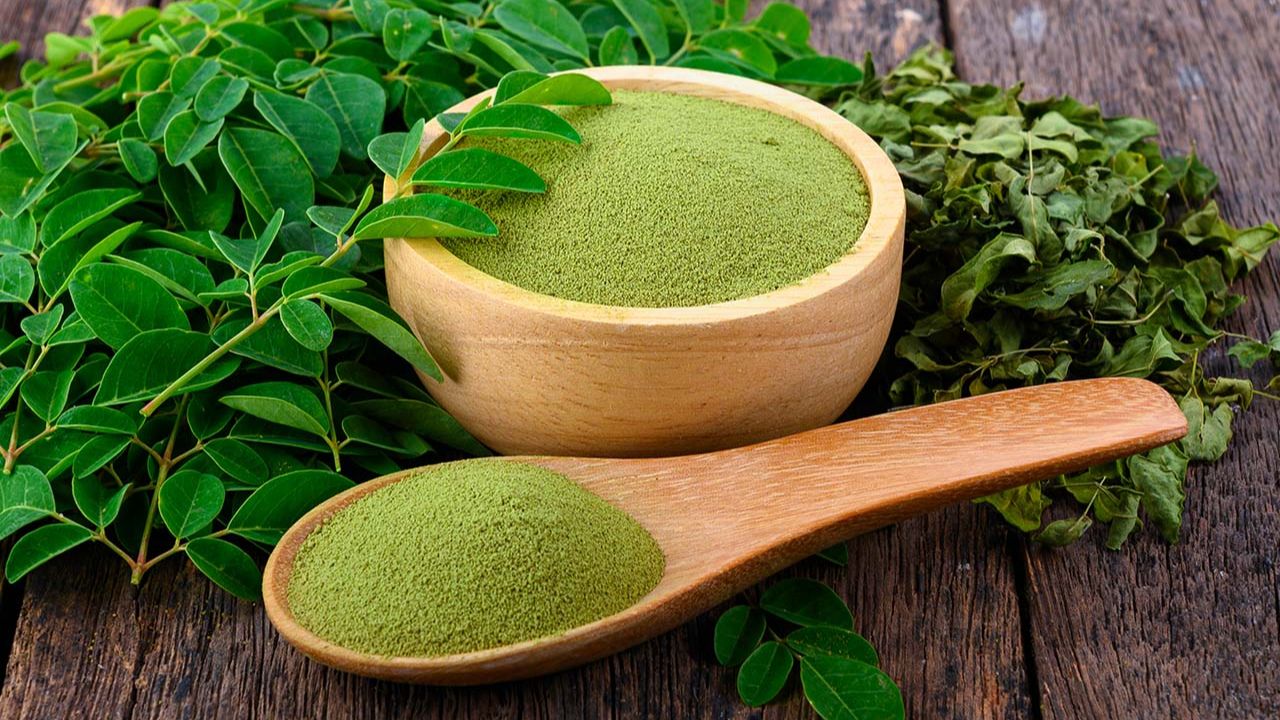
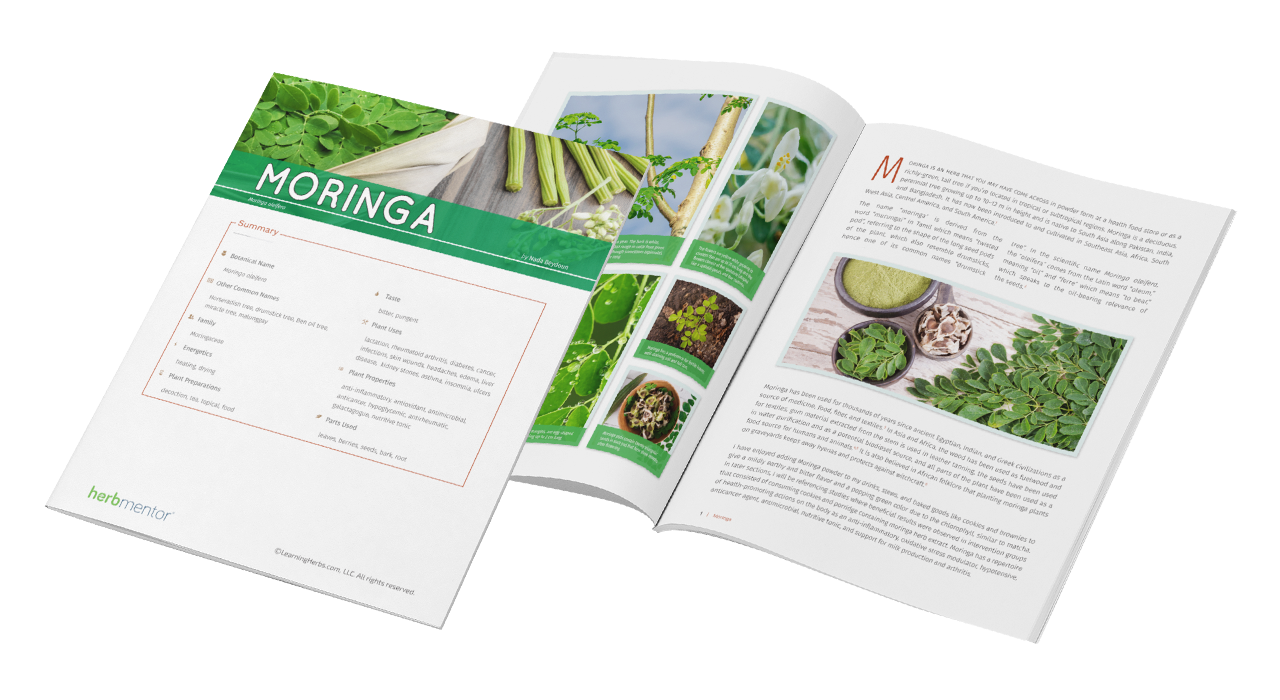
Moringa is an herb that you may have come across in powder form at a health food store or as a richly-green, tall tree if you’re located in tropical or subtropical regions. Moringa is a deciduous, perennial tree growing up to 10–12 m in height and is native to South Asia along Pakistan, India, and Bangladesh. It has now been introduced to and cultivated in Southeast Asia, Africa, South West Asia, Central America, and South America.1
The name “moringa” is derived from the word “murungai” in Tamil which means “twisted pod”, referring to the shape of the long seed pods of the plant, which also resemble drumsticks, hence one of its common names “drumstick tree”. In the scientific name Moringa oleifera, the “oleifera” comes from the Latin word “oleum,” meaning “oil” and “ferre” which means “to bear,” which speaks to the oil-bearing relevance of the seeds.2
Moringa has been used for thousands of years since ancient Egyptian, Indian, and Greek civilizations as a source of medicine, food, fiber, and textiles.3 In Asia and Africa, the wood has been used as fuelwood and for textiles, gum material extracted from the stem is used in leather tanning, the seeds have been used in water purification and as a potential biodiesel source, and all parts of the plant have been used as a food source for humans and animals.4,5 It is also believed in African folklore that planting moringa plants on graveyards keeps away hyenas and protects against witchcraft.
Moringa Uses and Plant Profile Summary
-
Botanical Name: Moringa oleifera
-
Other Common Names: horseradish tree, drumstick tree, Ben oil tree, miracle tree, malunggay
-
Family: Moringaceae
-
Parts Used: leaves, seed pods, seeds, bark, root
-
Energetics: heating, drying
-
Taste: bitter, pungent
-
Plant Properties: anti-inflammatory, antioxidant, antimicrobial, anticancer, hypoglycemic, antirheumatic, galactagogue, nutritive tonic
-
Plant Uses: lactation, rheumatoid arthritis, diabetes, cancer, infections, skin wounds, headaches, edema, liver disease, kidney stones, asthma, insomnia, ulcers
-
Plant Preparations: decoction, tea, topical, food
#block-1763760104645 { margin-top: 0px; margin-right: 0px; margin-bottom: 0px; margin-left: 0px; } #block-1763760104645 .block { border: 1px solid #f0f0f0; border-radius: 9px; background-color: #f8f8f8; padding: 0px; padding: 0px; padding-top: 15px; padding-right: 5px; padding-bottom: 15px; padding-left: 15px; } @media (min-width: 768px) { #block-1763760104645 { margin-top: 0px; margin-right: 0px; margin-bottom: 0px; margin-left: 0px; } #block-1763760104645 .block { padding: 0px; padding-top: 20px; padding-right: 20px; padding-bottom: 20px; padding-left: 20px; } } @media (max-width: 767px) { #block-1763760104645 { text-align: left; } } #block-1577982541036_0 .btn { margin-top: 1rem; } .awesomecontainer .row .block-type--accordion { align-self: flex-start; }
Want the Full Story on Moringa?
To continue reading this monograph and explore our full library of fully cited, in-depth herb profiles written by experienced and practicing herbalists, join HerbMentor, LearningHerbs’ online herbal education hub and welcoming community.
You can join HerbMentor for just $1 and see how it can support your own herbal journey.
Written by Nada Beydoun
Nada Beydoun is a registered herbalist with a BSc. in Microbiology and Immunology and Masters in Applied Human Nutrition. Her interests include SWANA region herbal medicines, and she has a community work background in refugee settlement and empowerment. You can follow her plant journey on Instagram @beybotany or her other socials here.
Footnotes
-
John A. Parrotta. Moringa Oleifera. USDA Forest Service, Research and Development, 2005, https://www.fs.usda.gov/research/publications/misc/63355_2005_%20Parrotta%20Moringa%20oleifera.pdf
-
Heredia, J. Basilio, and Erick P. Gutierrez-Grijalva, eds. Biological and Pharmacological Properties of the Genus Moringa. CRC Press, 2021.
-
Senthilkumar, Annadurai, Noushad Karuvantevida, Luca Rastrelli, Shyam S. Kurup, and Abdul J. Cheruth. "Traditional uses, pharmacological efficacy, and phytochemistry of Moringa peregrina (Forssk.) Fiori.—a review." Frontiers in pharmacology 9 (2018): 465.
-
John A. Parrotta. Moringa Oleifera. USDA Forest Service, Research and Development, 2005, https://www.fs.usda.gov/research/publications/misc/63355_2005_%20Parrotta%20Moringa%20oleifera.pdf
-
Liu, Rong, Jing Liu, Qi Huang, Shao Liu, and Yueping Jiang. "Moringa oleifera: a systematic review of its botany, traditional uses, phytochemistry, pharmacology and toxicity." Journal of Pharmacy and Pharmacology 74, no. 3 (2022): 296-320.
#block-1696522456141 { margin-top: 0px; margin-right: 0px; margin-bottom: 0px; margin-left: 0px; } #block-1696522456141 .block { border: 1px solid #ECF0F1; border-radius: 10px; background-color: #f8f8f8; padding: 0px; padding: 0px; padding: 0px; padding-top: 15px; padding-right: 15px; padding-bottom: 15px; padding-left: 15px; } @media (min-width: 768px) { #block-1696522456141 { margin-top: 0px; margin-right: 0px; margin-bottom: 0px; margin-left: 0px; } #block-1696522456141 .block { padding: 0px; padding: 0px; padding-top: 15px; padding-right: 15px; padding-bottom: 15px; padding-left: 15px; } } @media (max-width: 767px) { #block-1696522456141 { text-align: center; } } #block-1696522456141 .feature__image, [data-slick-id="1696522456141"] .feature__image { width: 100px; border-radius: 100px; } .authorfeature { display: flex; align-items: flex-start; position: relative; } .authorfeature__image-container { flex-shrink: 0; margin-right: 20px; } .authorfeature__image { max-width: 150px; height: auto; } .authorfeature__content { flex-grow: 1; } @media (max-width: 767px) { #block-1696522456141 .authorfeature { flex-direction: column; align-items: center; } #block-1696522456141 .authorfeature__image-container { margin-right: 0; } } #block-1773879332838 { margin-top: 0px; margin-right: 0px; margin-bottom: 0px; margin-left: 0px; } #block-1773879332838 .block { border: 4px black; border-radius: 4px; background-color: #fff; padding: 0px; padding: 0px; padding: 0px; padding-top: 20px; padding-right: 20px; padding-bottom: 20px; padding-left: 20px; } @media (min-width: 768px) { #block-1773879332838 { margin-top: 0px; margin-right: 0px; margin-bottom: 0px; margin-left: 0px; } #block-1773879332838 .block { padding: 0px; padding: 0px; padding-top: 30px; padding-right: 30px; padding-bottom: 30px; padding-left: 30px; } } @media (max-width: 767px) { #block-1773879332838 { text-align: left; } } #block-1773879332838 .accordion-title h5 { margin: 0; cursor: pointer; } #block-1773879332838 .accordion-body { padding-top: 24px; } #block-1773879332838 .accordion-title.collapsed:after { content: "\f067"; margin-left: 24px; } #block-1773879332838 .accordion-title:after { content: "\f068"; margin-left: 24px; color: ; } .awesomecontainer .row .block-type--accordion { align-self: flex-start; }
The Herbal Remedy Vault has all of our printable recipe cards...
Enter The Vault