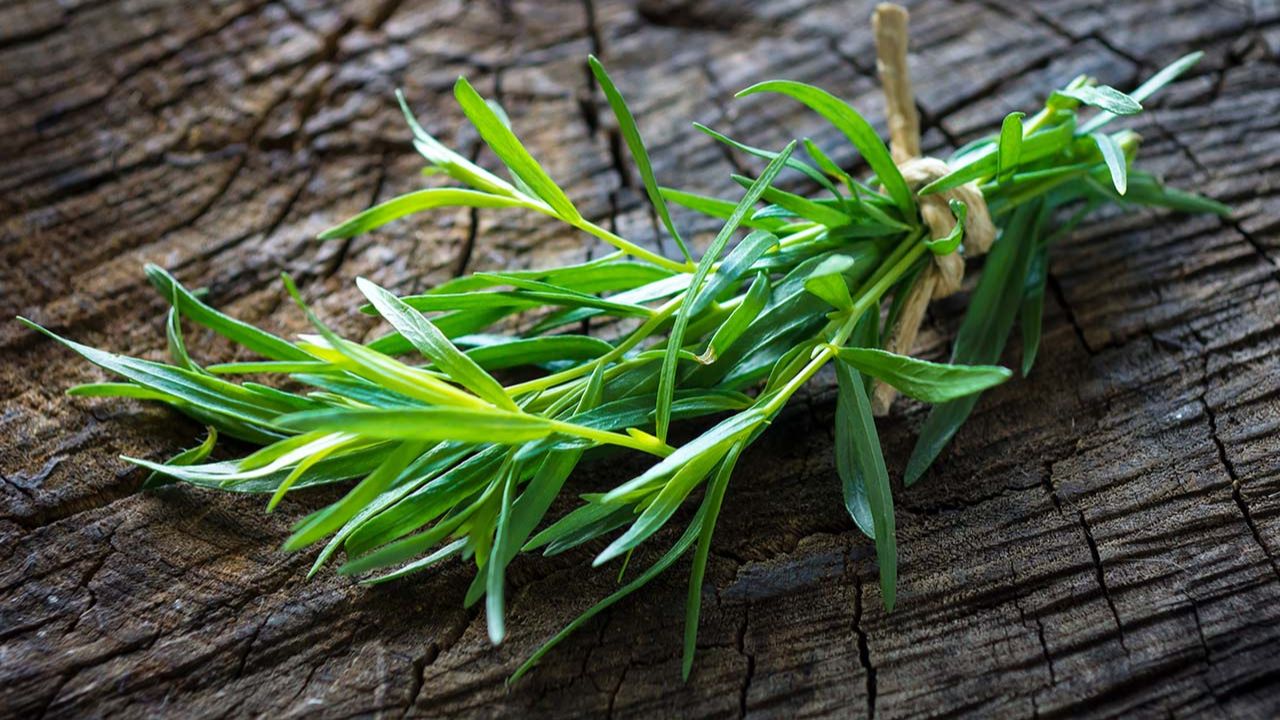
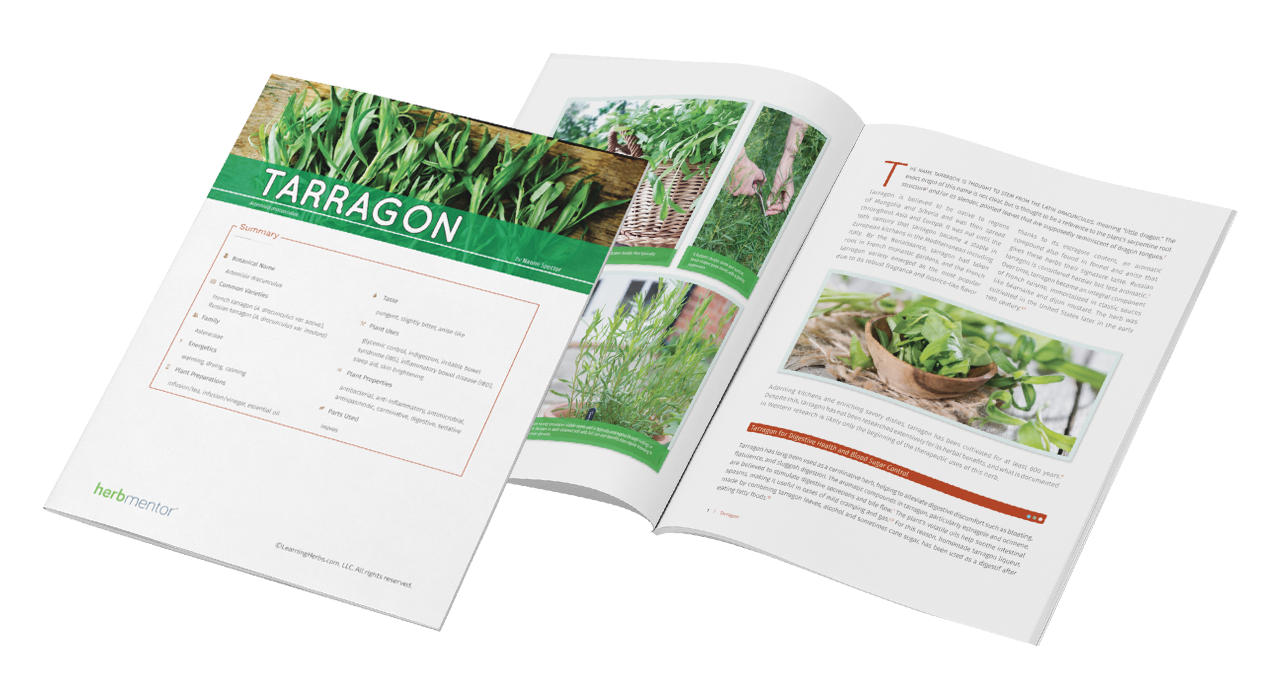
The name tarragon is thought to stem from the Latin dracunculus, meaning “little dragon.” The exact origin of this name is not clear, but is thought to be a reference to the plant’s serpentine root structure1 and/or its slender, pointed leaves that are supposedly reminiscent of dragon tongues.2
Tarragon is believed to be native to regions of Mongolia and Siberia and was then spread throughout Asia and Europe. It was not until the 16th century that tarragon became a staple in European kitchens in the Mediterranean including Italy. By the Renaissance, tarragon had taken root in French monastic gardens, and the French tarragon variety emerged as the most popular due to its robust fragrance and licorice-like flavor thanks to its estragole content, an aromatic compound also found in fennel and anise that gives these herbs their signature taste. Russian tarragon is considered hardier but less aromatic3. Over time, tarragon became an integral component of French cuisine, immortalized in classic sauces like béarnaise and dijon mustard. The herb was cultivated in the United States later in the early 19th century.4,5
Adorning kitchens and enriching savory dishes, tarragon has been cultivated for at least 600 years.6 Despite this, tarragon has not been researched extensively for its herbal benefits, and what is documented in Western research is likely only the beginning of the therapeutic uses of this herb.
Tarragon Uses and Plant Profile Summary
-
Botanical Name: Artemisia dracunculus
-
Common Varieties: French tarragon (A. dracunculus var. sativa), Russian tarragon (A. dracunculus var. inodora)
-
Family: Asteraceae
-
Parts Used: leaves
-
Energetics: warming, drying, calming
-
Taste: pungent, slightly bitter, anise-like
-
Plant Properties: antibacterial, anti-inflammatory, antimicrobial, antispasmodic, carminative, digestive, sedative
-
Plant Uses: glycemic control, indigestion, irritable bowel syndrome (IBS), inflammatory bowel disease (IBD), sleep aid, skin brightening
-
Plant Preparations: infusion/tea, infusion/vinegar, essential oil
#block-1763760104645 { margin-top: 0px; margin-right: 0px; margin-bottom: 0px; margin-left: 0px; } #block-1763760104645 .block { border: 1px solid #f0f0f0; border-radius: 9px; background-color: #f8f8f8; padding: 0px; padding: 0px; padding-top: 15px; padding-right: 5px; padding-bottom: 15px; padding-left: 15px; } @media (min-width: 768px) { #block-1763760104645 { margin-top: 0px; margin-right: 0px; margin-bottom: 0px; margin-left: 0px; } #block-1763760104645 .block { padding: 0px; padding-top: 20px; padding-right: 20px; padding-bottom: 20px; padding-left: 20px; } } @media (max-width: 767px) { #block-1763760104645 { text-align: left; } } #block-1577982541036_0 .btn { margin-top: 1rem; } .awesomecontainer .row .block-type--accordion { align-self: flex-start; }
Want the Full Story on Tarragon?
To continue reading this monograph and explore our full library of fully cited, in-depth herb profiles written by experienced and practicing herbalists, join HerbMentor, LearningHerbs’ online herbal education hub and welcoming community.
You can join HerbMentor for just $1 and see how it can support your own herbal journey.
Written by Naomi Spector
Naomi is a Jewish herbalist, ethnobotanist, and educator based in Massachusetts, on Pawtucket and Wampanoag land. Some of her favorite plants include garlic, pomegranate, chamomile, mulberry, and cedar. She hopes through her work as an educator and community herbalist to help connect folks to the plant traditions of their ancestors. Her practice draws on Sefardi, Ashkenazi and Mediterranean plant medicine traditions. She provides holistic plant-based care (physical, emotional, mental, and spiritual) to those seeking root cause changes in their lifestyle. Learn more about her work here: https://www.bibiandni.com.
Footnotes
-
Belsinger, Susan. 2014. Celebrate Artemisia: Herb of the year 2014.
https://www.finegardening.com/article/celebrate-artemisia-herb-of-the-year-2014 Accessed 01 March 2025.
-
Ekiert, Halina, et al. 2021. Artemisia dracunculus (Tarragon): A Review of Its Traditional Uses, Phytochemistry and Pharmacology. Accessed 01 March 2025. https://www.ncbi.nlm.nih.gov/pmc/articles/PMC8076785/
-
Utah State University. “How to Grow French Tarragon in Your Garden.” Usu.edu, 2020, extension.usu.edu/yardandgarden/research/french-tarragon-in-the-garden. Accessed 01 Apr. 2025.
-
Uyehara, Mari. “A Requiem for Tarragon.” TASTE, 26 July 2018, tastecooking.com/a-requiem-for-tarragon/. Accessed 01 Apr. 2025.
-
Maskevich, Adam. “Cumin: The Ancient Spice That’s Traveled the Globe.” KPBS Public Media, NPR, 11 Mar. 2015, www.kpbs.org/news/2015/03/11/cumin-the-ancient-spice-thats-traveled-the-globe. Accessed 2 Apr. 2025.
-
Uyehara, Mari. “A Requiem for Tarragon.” TASTE, 26 July 2018, tastecooking.com/a-requiem-for-tarragon/. Accessed 01 Apr. 2025.
#block-1712964864563 { margin-top: 0px; margin-right: 0px; margin-bottom: 0px; margin-left: 0px; } #block-1712964864563 .block { border: 1px solid #ECF0F1; border-radius: 10px; background-color: #f8f8f8; padding: 0px; padding: 0px; padding: 0px; padding-top: 15px; padding-right: 15px; padding-bottom: 15px; padding-left: 15px; } @media (min-width: 768px) { #block-1712964864563 { margin-top: 0px; margin-right: 0px; margin-bottom: 0px; margin-left: 0px; } #block-1712964864563 .block { padding: 0px; padding: 0px; padding-top: 15px; padding-right: 15px; padding-bottom: 15px; padding-left: 15px; } } @media (max-width: 767px) { #block-1712964864563 { text-align: center; } } #block-1712964864563 .feature__image, [data-slick-id="1712964864563"] .feature__image { width: 100px; border-radius: 100px; } .authorfeature { display: flex; align-items: flex-start; position: relative; } .authorfeature__image-container { flex-shrink: 0; margin-right: 20px; } .authorfeature__image { max-width: 150px; height: auto; } .authorfeature__content { flex-grow: 1; } @media (max-width: 767px) { #block-1712964864563 .authorfeature { flex-direction: column; align-items: center; } #block-1712964864563 .authorfeature__image-container { margin-right: 0; } } #block-1776382648575 { margin-top: 0px; margin-right: 0px; margin-bottom: 0px; margin-left: 0px; } #block-1776382648575 .block { border: 4px black; border-radius: 4px; background-color: #fff; padding: 0px; padding: 0px; padding: 0px; padding-top: 20px; padding-right: 20px; padding-bottom: 20px; padding-left: 20px; } @media (min-width: 768px) { #block-1776382648575 { margin-top: 0px; margin-right: 0px; margin-bottom: 0px; margin-left: 0px; } #block-1776382648575 .block { padding: 0px; padding: 0px; padding-top: 30px; padding-right: 30px; padding-bottom: 30px; padding-left: 30px; } } @media (max-width: 767px) { #block-1776382648575 { text-align: left; } } #block-1776382648575 .accordion-title h5 { margin: 0; cursor: pointer; } #block-1776382648575 .accordion-body { padding-top: 24px; } #block-1776382648575 .accordion-title.collapsed:after { content: "\f067"; margin-left: 24px; } #block-1776382648575 .accordion-title:after { content: "\f068"; margin-left: 24px; color: ; } .awesomecontainer .row .block-type--accordion { align-self: flex-start; }
The Herbal Remedy Vault has all of our printable recipe cards...
Enter The Vault